Have you ever wondered how much impact spending ten minutes a day filling in a few numbers can have on your brain? Sudoku, the globally popular logic game, is often seen as a way to pass the time. However, a growing body of scientific research suggests that it may be a seriously underestimated "brain gym."
This article will quote fromUnited States, United Kingdom, IranRecent research data from various countries reveals the true impact of Sudoku on the brain. Whether you're a casual player who plays occasionally for fun or a hardcore player who plays daily, this article will provide scientific evidence to help you train your brain more intelligently.
Want to start the challenge right away? Welcome to visit [website address]sudoku100This site offers a vast library of free Sudoku puzzles, ranging from beginner to expert difficulty, catering to different skill levels.
How Sudoku Can Reshape Your Brain? — Evidence from Neuroscience
1. Physiological changes: significant increases in BDNF and IGF-1
The effects of brain training are not only reflected in problem-solving speed, but also in measurable physiological indicators. (Published in 2025)EBNESINA JournalThis groundbreaking study provides us with strong data support.
The study, conducted by Sara Arman and her team, recruited 40 college student volunteers and randomly assigned them to four groups:Resistance training group, Sudoku training group, combination training group (resistance + Sudoku), and no intervention control groupThe intervention lasted for six weeks, three times a week. Researchers measured participants' serum brain-derived neurotrophic factor (BDNF) and insulin-like growth factor 1 (IGF-1) levels before and after the experiment—both key biomarkers of neural plasticity and cognitive function.
Key data:
- Significant changes in BDNFThe study found that serum BDNF levels in the Sudoku training group (who practiced Sudoku alone) showed an increase.A statistically significant increase (p < 0.001)This means that cognitive training through Sudoku alone can promote the secretion of "brain fertilizer," supporting the growth of new neurons and the formation of synapses.
- Advantages of combined trainingAlthough Sudoku training alone did not significantly improve IGF-1, when Sudoku was combined with resistance training, the combined training group showed improvements in BDNF, IGF-1, and working memory.The most significant improvement (p < 0.001)The effect is better than performing any one training exercise alone.
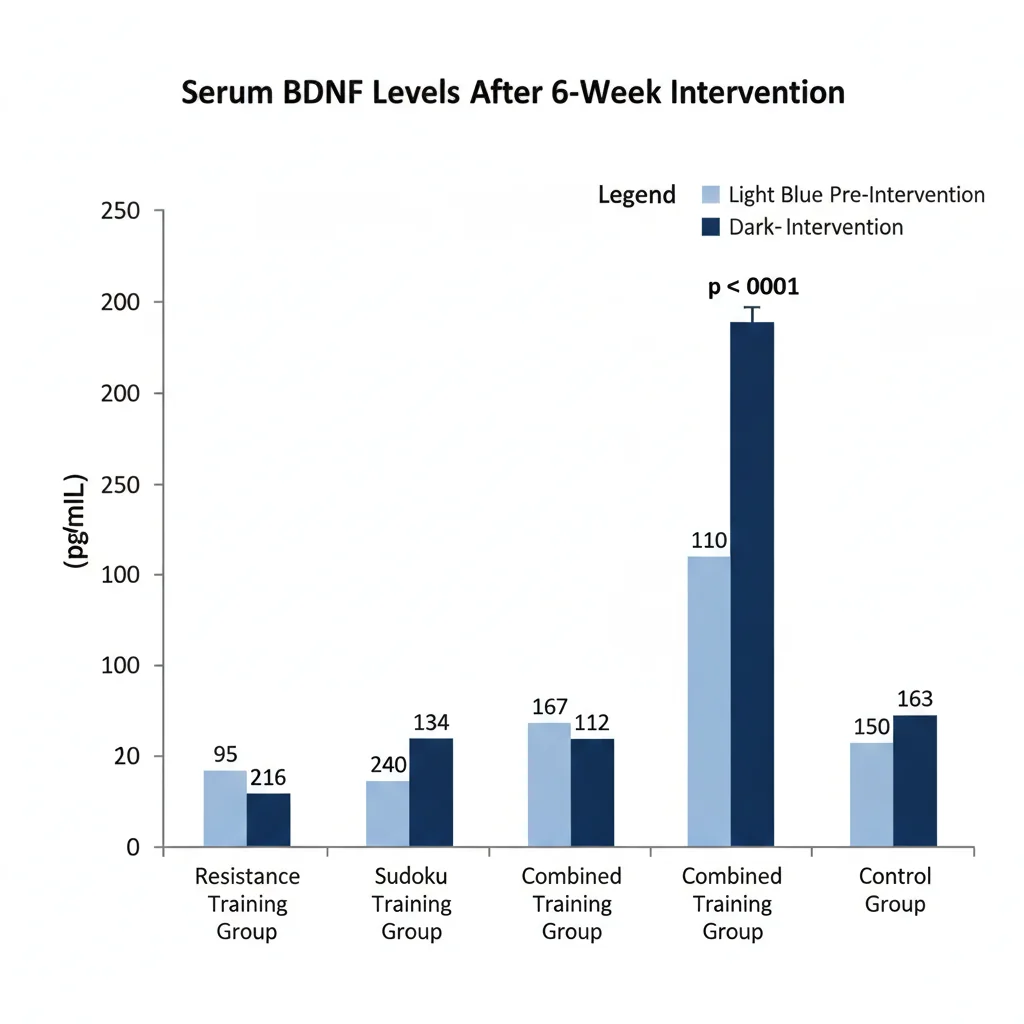
Comparison of BDNF level changes in different groups after six weeks of intervention
2. The Shaping of Attention Networks: An Exploration at the University of Albany
If Iranian research focuses on "biochemical indicators," then...State University of New York at AlbanyThe research focuses on "behavioral performance." Mauricio Rodriguez, a graduate student in psychology at the university, presented his research on the relationship between Sudoku and attention at the university's 2025 showcase.
Rodriguez designed an experiment and recruited...200 peopleUniversity students participated. The experimental group was asked to first spend 10 minutes solving a Sudoku puzzle, then complete a letter detection task to measure attention; next, they solved a maze and were tested again. The control group watched a nature documentary.
Research Findings and Future Prospects:
- Limitations of short-term effectsThe research results show thatsingleTen minutes of Sudoku practice did not immediately result in a significant improvement in attention test scores. Rodriguez points out that this is not surprising, as the effects of cognitive training are often cumulative and cannot be expected to be immediate.
- The theory of "progressive overload"Rodriguez offered a highly insightful observation: "Think of a weightlifter. Muscles only get stronger through progressive overload, constantly increasing the weight. The brain works the same way." He argued that playing only easy Sudoku puzzles might offer limited cognitive development.Gradually increase the difficulty of the puzzlesThis forces the brain to consume more "mental resources" in order to achieve better training results.
- Future directionRodriguez will next join the school's PhD program in cognitive psychology to continue his in-depth research on this topic and attempt to develop a more scientific Sudoku difficulty rating system.
The "Guardian" of the Elderly Brain: Evidence of Sudoku's Anti-Aging Power
As people age, cognitive decline is a concern for many. Sudoku, however, has shown remarkable potential in protecting the cognitive health of older adults.

1. The secret to making your brain "10 years younger"
Published in 2014International Journal of Geriatric PsychiatryA British study has provided us with one of the strongest epidemiological evidences to date. The study was conducted by...University of Exeter and King's College LondonJointly completed, for more than19,000Participants aged 50 to 93 were followed up.
Key data:
- Significant positive correlation with cognitive performanceRegression analysis shows thatThe frequency of playing Sudoku or similar puzzles was significantly positively correlated with scores on grammatical reasoning ability, spatial working memory, and episodic memory.。
- brain age is getting youngerIn layman's terms, this study suggests that older adults who frequently play Sudoku or crossword puzzles exhibit brain function that is more advanced than their actual age.10 years youngerEspecially in short-term memory tests, their performance far surpasses that of their peers.
- Targeted protectionThe study specifically points out that grammatical reasoning and episodic memory are...Most susceptible to decline with ageThe cognitive domain. And Sudoku is closely related to performance in both of these domains, which means that playing Sudoku regularly may be a targeted "cognitive protection" strategy.
2. Visual evidence of brain functional areas: fMRI studies
The effects of Sudoku on the brains of older adults can even be directly "seen" through brain scans. (Published in 2012)Journal of the Neurological SciencesA functional magnetic resonance imaging (fMRI) study has revealed the answer to this mystery.
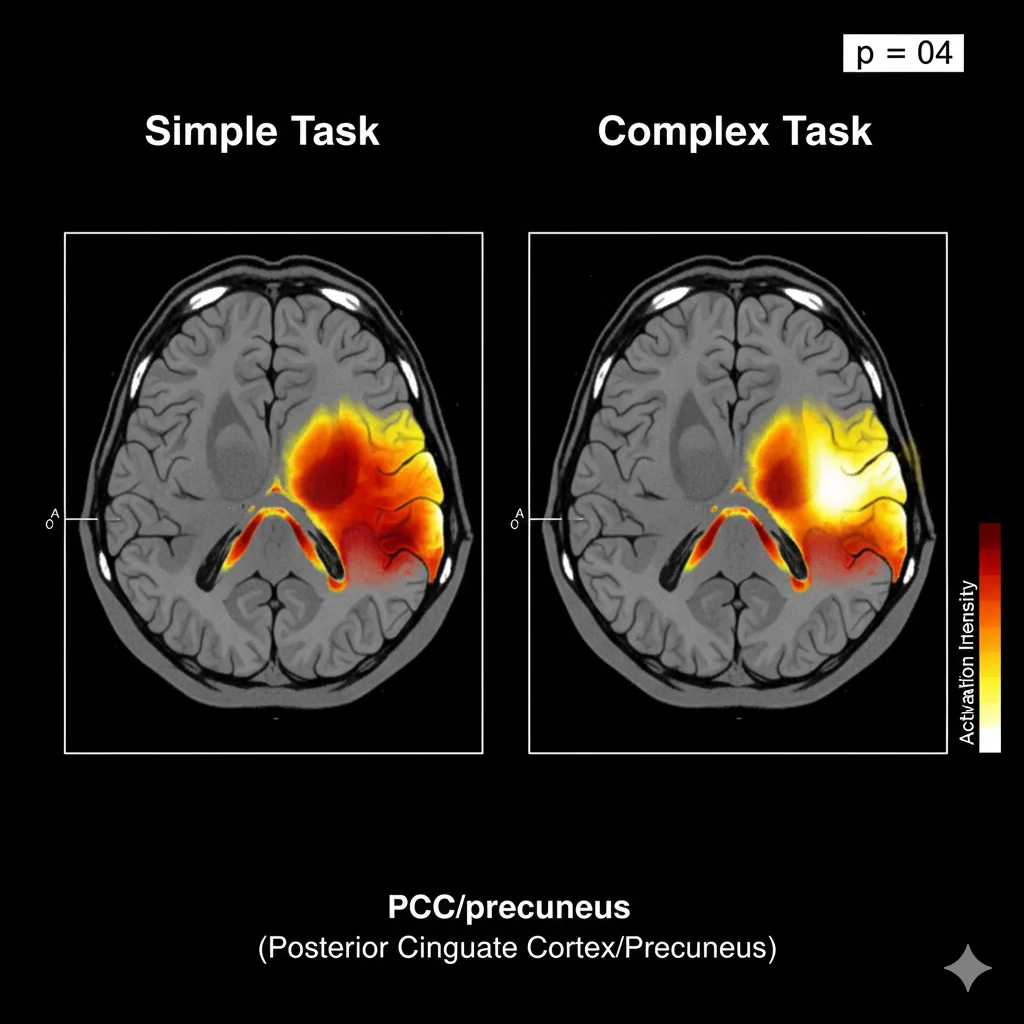
A research team led by Guangwei Jin had 18 healthy elderly individuals (average age 63.6 years) solve a simplified 4x4 Sudoku task using an fMRI scanner. The task was divided into two types: a simple task (requiring only row rules or column rules) and a complex task (requiring both row and column rules).
Key findings:
- Activation patterns of specific brain regionsResearch has found that older adults are more adept at solving Sudoku problems.Significant deactivation was observed in the bilateral posterior cingulate cortex (PCC) and adjacent precuneus regions.。
- The higher the difficulty, the stronger the activation.More importantly,Complex tasks elicit significantly greater levels of negative activation than simple tasks.(Left side p=0.04; Right side p=0.04). The posterior cingulate cortex is a key node in the brain's default mode network, which is active when people are daydreaming or resting, but inhibited when they are focused on a task. This finding suggests that Sudoku tasks can effectively mobilize the brain resources of older adults, and the more difficult the task, the higher the level of focused engagement.
3. More than just cognition: Positive changes in personality traits
The benefits of cognitive training may even extend to the personality level. (Published in 2012)Psychology and AgingA randomized controlled trial published in the journal found that cognitive training can alter personality traits in older adults.
University of Illinois at Urbana-ChampaignThe research team had older adults complete a 16-week inductive reasoning training program, andEach week is supplemented with crossword puzzles and Sudoku puzzles.Through a 30-week follow-up evaluation, they found that:
- Enhanced opennessCompared with the waiting control group, the elderly in the intervention group had...Openness to experienceThis personality trait was significantly improved (p < 0.05). Openness signifies receptiveness and curiosity towards new things and experiences. This is positive for older adults to maintain social activity, learn new skills, and adapt to later life. The study authors noted, "Adjusting the difficulty of training programs alongside skill development may be crucial for enhancing openness. As reasoning abilities increase, older adults may be more able to enjoy intellectual challenges and creative activities."
How to scientifically train your Sudoku skills?
Based on the above research, simply "playing" may have limited effects; strategic training yields better results. Here are some practical suggestions:
1. Consistency is key: High-frequency, short-duration methods are more effective.
- suggestionInstead of playing for two hours at a time on the weekend, it's better toSet aside 10-15 minutes each dayResearch from the University of Exeter indicates that...Play more than once a dayPeople who play brain-training games score the best on cognitive tests. High-frequency, regular stimulation is more effective at strengthening neural connections than occasional, overwhelming stimulation.
2. Challenge yourself: Follow the principle of "gradual overload".
- suggestionIf you can easily solve easy and medium-difficulty Sudoku puzzles, it's time to move up. As researchers at the University of Albany have emphasized,Only through progressively increasing the workload and gradually raising the difficulty level can the brain become stronger.Try tackling one or two challenging problems each week that really get your brain working; this will force your brain to use more of its "mental resources."
Want to challenge yourself with something more difficult?sudoku100Offering daily updated expert-level Sudoku puzzles with difficulty levels, it's the ideal platform for achieving "progressive overload".
3. Synergistic effect: Combining mental and physical labor
- suggestionThe research on Iran reveals an important pattern:The combined intervention of "resistance training + Sudoku" is more effective than either of them alone in improving BDNF and working memory.This is because physical exercise promotes the production of neurotransmitters, while mental training optimizes the utilization of neural connections. Try sitting down and playing a game of Sudoku after exercising or taking a walk; it might yield twice the results with half the effort.
in conclusion
Sudoku is much more than just a way to kill time. From...Boost key neural factors such as BDNFMolecular evidence, tofMRI showing activation of brain functional areasAnd thenMake your brain 10 years youngerThrough large-scale population studies, the scientific community is gradually uncovering the "brainpower code" behind this logic game.
For middle-aged and elderly people, it is a scientifically proven and effective tool for slowing down cognitive aging; for young people and college students, it may be a "cognitive enhancer" that optimizes working memory and improves concentration. It does not require expensive equipment, is not limited by location, and only requires you to devote a few moments of focused attention each day.
The next time you pick up a pen, or open...sudoku100As you prepare to fill in the numbers, remember: you are undertaking a scientific and efficient brain reshaping project.
References:
- Arman, S., Shamsaei, N., & Abdi, H. (2025).The combined effect of six weeks of resistance training and Sudoku mental exercise on serum BDNF, IGF-1 levels, and working memory in university students. EBNESINA Journal, 27(2).
- Rodriguez, M. (2025).The Impact of Puzzles on Short-Term Attention. Honors College, University at Albany.
- Ferreira, N., et al. (2015).Associations between cognitively stimulating leisure activities, cognitive function and age-related cognitive decline. International Journal of Geriatric Psychiatry.
- Jin, G., et al. (2012).fMRI study in posterior cingulate and adjacent precuneus cortex in healthy elderly adults using problem solving task. Journal of the Neurological Sciences, 318(1-2), 135-139.
- Jackson, JJ, et al. (2012).Can an old dog learn (and want to experience) new tricks? Cognitive training increases openness to experience in older adults. Psychology and Aging.
- Arman, S., et al. (2025).Search results for Insulin-like growth factor-1. EBNESINA Journal.
- University at Albany. (2025).Showcase 2025: UAlbany Senior Explores the Psychology of Sudoku.
- Game Sudoku Online. (2026).Are there scientific studies on the benefits of Sudoku?
- Jin, G., et al. (2012).fMRI study in posterior cingulate and adjacent precuneus cortex in healthy elderly adults using problem solving task. ScienceDirect.
- University of Illinois Urbana-Champaign. (2012).Enhancing cognition in older adults also changes personality.